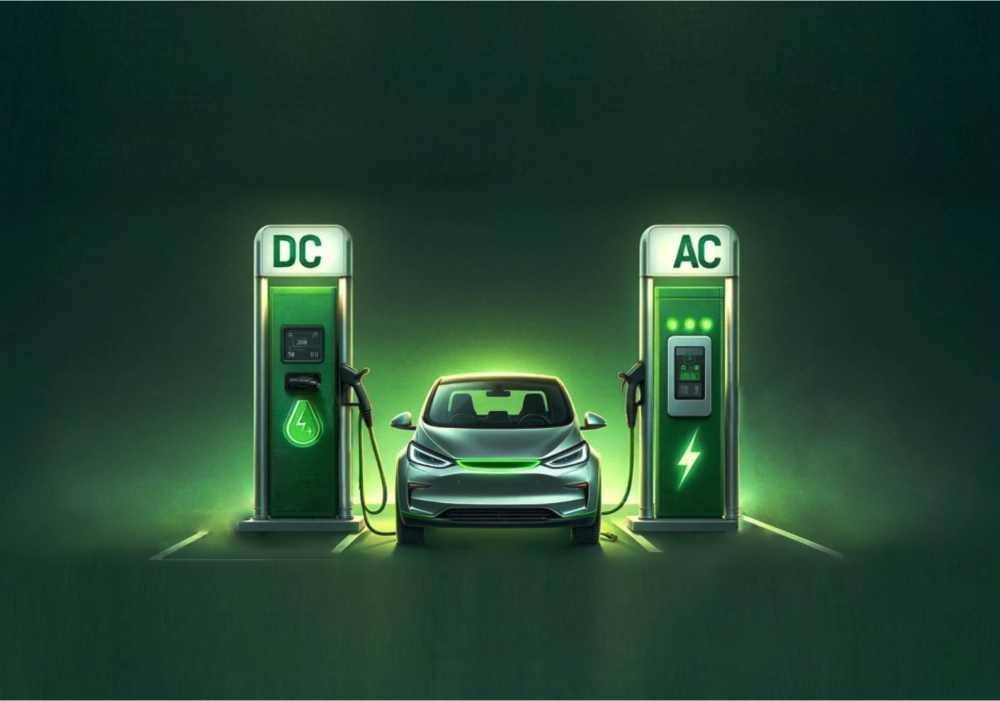
Electric vehicle charging stations are of three types that are Level 1, Level 2 and Level 3 charging stations. Level 1: Level 1 charging equipment could easily be installed in homes, as the voltage requirement for this level is 120, which is easily available in residential areas. However, Level 1 is kind of AC charging station , is the slowest form of charging and is suitable for overnight charging at home. One more thing, it is the cheapest method of charging your EV. Level 2: Level 2 is also a form of AC charging for which voltage requirement is around 240. This charging equipment can be installed at home, public spots like parkings of workplaces and shopping malls. Level 3: Level 3 (Tesla supercharging) is the fastest form of charging an electric vehicle. The voltage requirement is quite high, between 200 and 600. As it uses DC charging, the stations providing it are also called DC charging stations . Fundamental Contrast between AC Charging Stations and DC Charging Stations Many of the differences are there between AC charging stations and DC charging stations which are mentioned below: 1) Site of Power Conversion: It is important to understand that the power which comes from the electricity grid is always AC but every electric vehicle receives only DC power. So, AC power is converted into DC in two ways : either inside the car or outside the car. All the electric vehicles have a built-in onboard charger, a gateway which converts AC power into DC and this is the only way of charging an electric vehicle. The other method of converting the power is using a DC charging station and these stations are equipped with a converter, which is the reason behind why they are called Fast charging stations . 2) Types of chargers: A wide array of AC and DC chargers is being offered by the manufacturers of EVs. Some are suitable for an individual owner and others for public charging stations . The range of AC charger is 3.3 kW, 7.2/7kW type-2, 10kW shared AC-001 and it is 1kw for hybrid AC charger. However the range of DC charger is more in comparison to its counterpart and it is 15kW, 30kW, Dual Gun 60kW and 120kW capacities. 3) Home charging with AC Chargers: AC chargers as mentioned above require low voltage which is easily available in residential areas, so with AC charging, one can easily charge a vehicle at home. One can plug in the vehicle overnight and make it ready to go in the morning. It proves to be a very cost effective method of charging. Although DC charging station installation can be done at home, it is not sensible to do so, as the voltage requirement is quite high and all the residential areas don't get that, so they require high power connection to the grid. Apart from this, they are very expensive in comparison to AC ones and the space requirement for their installation is much more. 4) Mobile Charging with AC: AC chargers are very heavy, so are not portable but AC chargers can be carried along on a trip. Apart from weight, DC chargers require more voltage, so finding a power source is not easy. 5) Charging Time: It is clear from the above mentioned information that AC chargers are being equipped with the converter, so the onboard charger located inside the car is being bypassed by the DC charging station, which leads to 10 times faster charging than AC and saves a lot of time. AC chargers, on the other hand, take a very long time to charge a small battery pack and due to this, they prove to be unsuitable for vehicles with large batteries. 6) Charging Curve: Another difference between these clean energy solutions is the shape of the curve. With AC charging, the power is delivered in the form of a flat line because the size of the onboard charger is very small. However, the charging curve in case of DC charging stations is degrading because at the initial stage the vehicle requires more energy and when it reaches its capacity, it starts accepting slower flow. 7) Cost: It is clear that AC chargers are the fastest ones and require more voltage, they are the expensive ones. So, if a user is in a hurry to go somewhere, then it is very feasible to get the electric vehicle charged from the DC EV charging network but for daily use it can be heavy on the pocket of the user. AC EV charging benefits are many, they are the cheapest ones, one can install at home which proves an even more cost-effective solution, as the cost starts from 20-22 thousand and goes up to 70-75 thousand for 11kW charger. Moreover, one can feasibly charge in office parking while working and in shopping mall's parking while shopping. 8) Charging Time: It is clear from the above mentioned information that AC chargers are being equipped with the converter, so the onboard charger located inside the car is being bypassed by the DC charging station, which leads to 10 times faster charging than AC and saves a lot of time. AC chargers, on the other hand, take a very long time to charge a small battery pack and due to this, they prove to be unsuitable for vehicles with large batteries. 9) Accessibility to the Compatible charger: Although you can have the availability of both AC and DC chargers in the market, their patterns and workings are totally different. DC chargers can only be seen installed at public charging stations but AC ones can be installed at home also. Every charger is not compatible with every vehicle but there is a device which ensures chargers' compatibility with the vehicle. Overall, both the chargers have their own unique working, performance, efficiency and cost. One should always make an informed decision by considering all the aspects of both. For more information, you can reach us at any time, our team is always at your service.