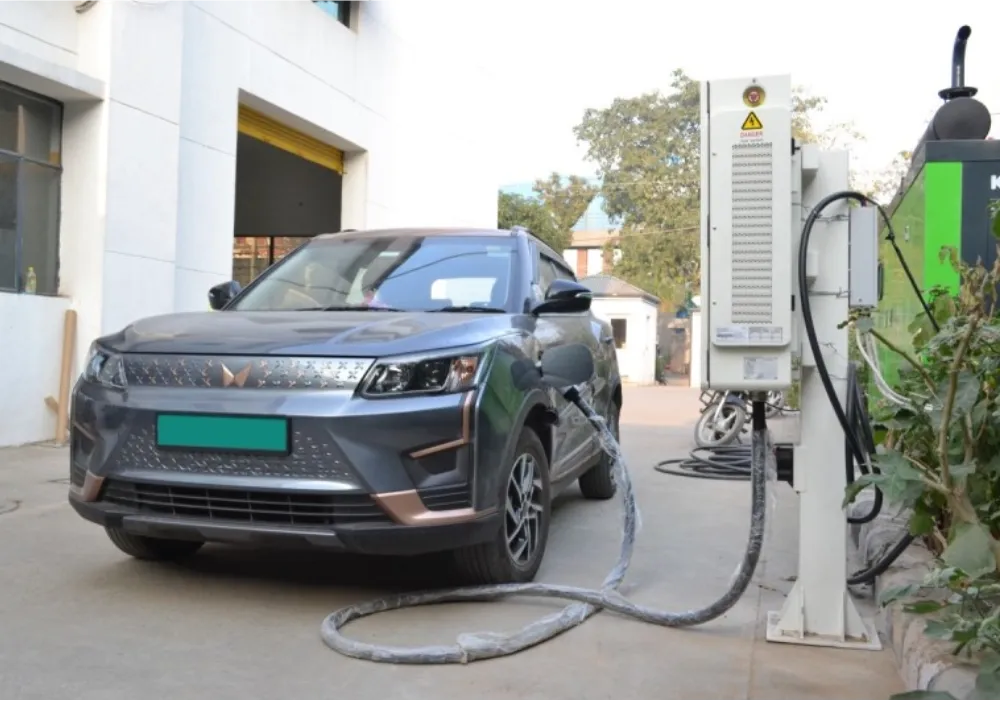
Inevitably, the Indian automobile industry has seen a rapid growth since a couple of decades and is accelerating at a faster pace. The astonishing change to notice is that people's inclination has now started to grow towards electric vehicles and to everyone's surprise, India would have 44 million electric vehicles till 2030. Governments of different states are providing tax incentives and other subsidies not only for buyers but also for manufacturers with the agenda of increasing adoption of electric vehicles . Government is promoting the use of EVs among people in order to reduce carbon-footprint and save fossil fuels from getting depleted. Although the government has played an indispensable role in promoting the usage of EVs, the role of infrastructure in this revolutionary transformation can not be ignored and its increasing demand further accelerates the requirement of efficient and groundbreaking charging solutions. Here, we will discuss the latest market trends and innovations in the EV. EV Charging Evolution: Latest Market Trends and Innovations Plug and charge method: Traditionally, when EV owners would go to charging stations, they had to use RFID cards for initiating charging and paying bills. With the passage of time, improvements were made and people were able to pay through mobiles applications (credit cards, digital wallets) and then they were also allowed to pay through their debit cards. But the plug and charge method also called in-vehicle billing has added lots of conveniences to the life of people. As now, EVs are assigned their unique digital certificate and are provided with a secure communication module. When people take their vehicles to electric vehicle charging stations , they just need to plug in the charger and their vehicle is recognised instantly by charging stations with the help of a digital certificate. Following this, secure communication is initiated between vehicle and the charging station, and then billing information is verified automatically. After the authentication of the vehicle, charging of the vehicle starts and the user does not need to provide any input from his side. Smart EV charging: The main aim of operators of charging stations is to make user experience better and efficient. This has led to acceleration in the smart charging stations across the world which offer smart payment options like plug and charge, and reservation systems, where users can reserve a place and time for their vehicle and then get it charged conveniently. Vehicle-to-grid technology: Traditionally, there was availability of unidirectional charging only but as improvements are being made everyday, V2G charging has come into existence. It is a method where a vehicle not only gets electricity from the grid to charge but can also send surplus energy back to the grid. This is a great solution to fulfil electricity demand in the peak hours. Moreover, drivers who participate in the program get financial benefit from the government which can help them to stabilise their cost of charging. The Open Charger Point Protocol (OCPP): It is a system which ensures seamless communication between the charging stations and management. Operators can keep an eye on the performance of charging equipment and can do all the updates remotely, thereby, reducing the downtime and ensuring optimal performance. Even users can keep a check on the charging status of their vehicle along with checking the consumption of energy. New Business Models: With advancement in every aspect of EV charging, new business models are coming into existence to provide seamless user experience. Among them, one of the most beneficial is subscription based charging. Charging station operators have started to provide subscription plans to their users. Users can select the plan according to their requirement and can pay regularly, monthly or annually on the basis of the plan they have chosen. Users get many benefits from this approach like they get services at discounted rates and also get priority among others at charging stations. Not only at one particular station, they get these benefits at multiple charging stations managed by the same operator. Even they get easy access to charging at public parking spots. Advancement in battery technology: There have been many improvements in the battery technology also, firstly, the energy density has been increased in the modern day lithium batteries, as more energy can be stored in them without any changes in the physical space of them. Secondly, the adoption of modern manufacturing techniques have helped in extending the lifespan of the batteries. Moreover, these batteries coupled with improved charging equipment take less time to get charged. Eventually, it can be said that these continuous improvements are surely going to accelerate the use of Electronic Vehicles in the future. Such facilities and improvements would encourage more and more individuals to show their inclination towards EVs and this would be a huge step towards saving our natural resources, environment and our whole ecosystem and biodiversity.